


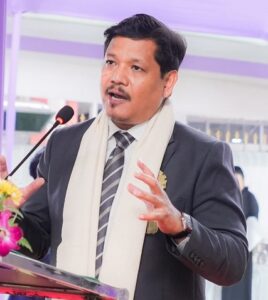
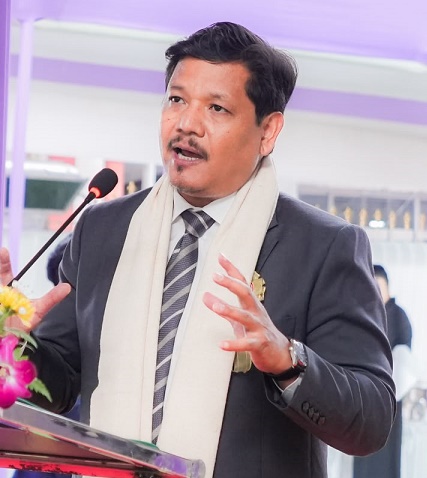
SHILLONG, NOV 28: Meghalaya Chief Minister Conrad K Sangma today termed that education is a complex sector but Government through systematic intervention is making an effort to overcome the challenge.
Terming that education will remain the top priority for the government, he said that the government’s commitment to education is not just in words but in action, determination and every small effort to ensure that education improves.
He made the remark while addressing a gathering in Tura during the distribution of Tablet PCs under SHCDM – II at CRC & BRC conclave.
Education Minister Lahkmen Rhymbui was also present in the day-long conclave.
During the conclave officials of Block Resource Centres (BRCs) and Cluster Resource Centres (CRCs) from across Garo Hills were given tablet PCs. A total of 372 tablets were handed over in today’s programme.
Addressing the CRCs, BRCs, officials of the district administration and education department, the Chief Minister said that education cannot be transformed by the government alone and that everybody has a role to play.
“It is like an orchestra trying to play a piece of music, where every instrument must be played properly, in time, in synchronisation. Otherwise, the music will sound like noise. But when everything is synchronised, that’s when music is made,” he said, underlining the need for teamwork.
He said that governance today is based on data-driven decisions, and that timely, detailed and correct information is essential for making the right policies.
Citing the work done by BRCs and CRCs, the Chief Minister said that their field data had directly shaped major government decisions.
He informed that BRCs and CRCs had visited 32,000 teachers, verified their qualifications and other issues, and the feedback received helped the government to come up with the pay framework, a decision that impacted 23,000 teachers.
He further said that in about 600 villages visited, data showed that about 3,200 to 3,500 children were out of school. That information enabled the government to come up with different programmes to bring those children back into the education system.
Similarly, data collected from visiting 5,000 schools on infrastructure – whether toilets are available, whether electricity is available – has helped the government to make correct decisions on school infrastructure.
The Chief Minister said that with technology, real-time data is now possible and the government is trying to expand real-time assessment across departments.
Recalling the case of ASHA workers, he said there was a time when they did not receive their incentives for almost six-and-a-half to seven years. Real-time data helped the government to resolve the issue, and the same technology is now being implemented everywhere.
“What we are doing today is going to empower you to be able to provide us that information on a real-time basis so that we can take decisions which are also real and as timely as possible,” he said.
Stating that education is a very complex sector, the Chief Minister said that knowing what is right is easier than knowing how to implement it correctly.
“What you do is important, but how you do it is even more important. And that’s really the challenge we face in education, and in governance as a whole, but in education even more,” he said.
He added that the human aspect involved in education has made the sector even more complex, as it involves a network of human emotions and challenges that must be balanced while taking decisions and implementing them.
He, however, said that in the nine years of the MDA government, the State has come a long way and is moving in the right direction.
“Things are moving forward. We are in the right direction, as I keep saying. And what we are doing today will strengthen the entire aspect of what we will be doing in the days to come,” he said.
Stressing that technology is only a facilitator and not a problem solver in itself, the Chief Minister said every decision must be driven by what is good for the child.
“Technology is only as good as you use it. Technology cannot be a problem solver. It can facilitate, it can help, it can support solving a problem. At the end of the day, we have to remember that we are here for that little boy or little girl – the students and the youth of our State. We must never forget that,” he said.
He told the CRCs and BRCs that they have the power in their hands to possibly change the life of a child, and that they are the link between the child and his future, and between the child and the government.
“That thought has to be right inside your heart. It’s not even your mind, it’s your heart. At the end of the day, nothing will matter if our heart is not in the right place,” he added.
The Chief Minister also highlighted that he never says no to any programme on education, however big or small, because giving time – the most scarce resource – is the true reflection of priority.
He urged all stakeholders to continue visiting the grassroots, stating that without visiting the grassroots, nothing can happen.
Referring to CM Connect as one of his favourite programmes, the Chief Minister said that though it is difficult because it involves listening to complaints, that is how governance gets things done.
By Our Reporter